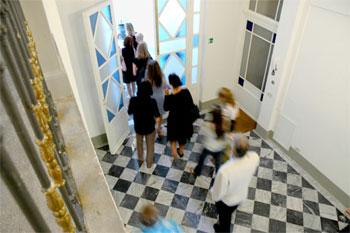
On the 17th of February, Villa Romana opened its doors to the public to see the work of the fellows who had been living there for the past 10 months. The exhibition presented works by Andrea Beliu, Matei Beilu, Carina Brandes, Kasia Fudakowski, Stefan Pente, and Farkondeh Shahroudi. The Villa Romana is a place where people from all over the world come to see and talk about contemporary art. Since 1905, the Villa has been a host for art fellows to live, learn, work, and exhibit their art. It also organizes other exhibitions and events throughout the year. The goal of the Villa Romana is to create a place for international artists and the public to discuss and meditate on the cultures of the Mediterranean area.

Upon entering the Villa Romana, I was intrigued by everything I saw around me. I noticed as I walked through each room that none of the work had an artist’s name or title of the work. This made it a little difficult to differentiate each artwork from each artist. But it also made it easier to focus on the artwork in front of me and to make my own interpretation rather than try to see what the artist was going for in their piece.
The work that spoke to me the most were photos by Carina Brandes, a young, German artist. Brandes describes her art as a translation of genres, as she uses analogue black and white photography but calls upon other forms of art like painting, sculpting, and performance. She uses mostly female models but also her own body as a subject using a timer on the camera and letting go of having control over the frame of the picture. This is something that every photographer struggles with is choosing between controlling the scene in front of the camera or controlling the effects of what happens behind the camera. She uses a variety of props including taxidermia, honey and flour, wall paint, and paper cutouts.

Some of my favorite photos of her collection were Ohne Titel, 2014, pictured above with two people jumping, and this one to the right that was untitled. Her expressive use of the feminine body comments on various aspects of humanity. Although I did not speak with the artist nor does she personally provide any insight on the meaning of her portraits, I believe that she focuses on the different aspects of womanhood and the female body to expose problems in cultural views of women and to depict personal stories. In the photo on the right, it looks as if a female figure had struggled to climb a wall with her legs and feet covered in a dark, ink like substance. Brandes might be depicting the struggle a woman has with her body especially when it comes to its regular functions like menstrual cycles.

Another work that caught my eye was not entirely known as a section of the gallery. Andrea Beliu and Matei Beliu, two German videographers, created this installation with napkins. I was fortunate enough to speak with Matei Beliu at the event about the piece as I was slightly confused why stacks of napkins were placed in the common area where people were gathering to eat and drink and it was easy for them to fall over. This was his exact objective, to have the piles of napkins fall. Matei commented that his inspiration was the idea of hope – the higher your hope, the easier and further it has to fall. Those that were left standing at the end of the night were the shorter and more protected ones.


I enjoyed seeing the variety of works at the Villa Romana and having the opportunity to speak with the artists and other guests that came to view the opening. The arrangement of every work in the Villa provided a similar air of confusion that was more thought provoking so that it seemed purposeful rather than unintentionally disorganized. I think my favorite placement of artwork was by the Tehrani artist, Farkhondeh Shahroudi. These works were two words made from clothe stitched together, one placed in the first room in a corner by the door, and the second in the last room on a wall facing the door you entered. The words “oh” and “ah” brought the theme of the exhibition as every piece of artwork had you standing in front of it for a moment until a moment of realization came about you.